
Brand Colors: What They Mean and How to Choose Yours
 9 min read
Brand colors are often the first thing people notice about a business and one of the last things they forget. Before anyone reads your name or your tagline, the colors on your logo, website and packaging have already set a mood: calm or loud, premium or friendly, serious or playful.
This guide covers colors and branding from end to end. You will see how color shapes brand perception (and what the research really says), what each main color tends to signal, and a step-by-step method for building a brand color palette that works on screen, in print and for people with different kinds of vision.
How color shapes brand perception
Color does two jobs for a brand. The first is recognition. Used the same way everywhere, a color becomes a shortcut to your brand, so people can spot your product on a shelf or your app on a home screen without reading a word. The second is meaning. Colors carry associations, and those associations rub off on the brand that uses them.
Research backs up the second point, with some care needed. In Exciting red and competent blue, Labrecque and Milne ran four studies on color in marketing. They mapped hues onto brand personality traits, showed that saturation and lightness can strengthen those traits, and found that changing a logo’s color can shift how people see a brand and whether they intend to buy from it.
Many color associations are also widely shared. A study of 4,598 people in 30 nations found broadly similar links between colors and emotions across countries, but also local differences shaped by language and geography. In other words, red will read as energetic almost everywhere, while the finer meanings of a color can change from one market to another.
Be wary of neat percentages about color and sales that circulate online. Most cannot be traced to a real study. A review of color psychology research by Andrew Elliot describes the field as still at an early stage and calls for caution about real-world claims. The practical lesson: there is no magic color. What matters most is that the color fits what you sell and who you sell it to, then stays consistent.
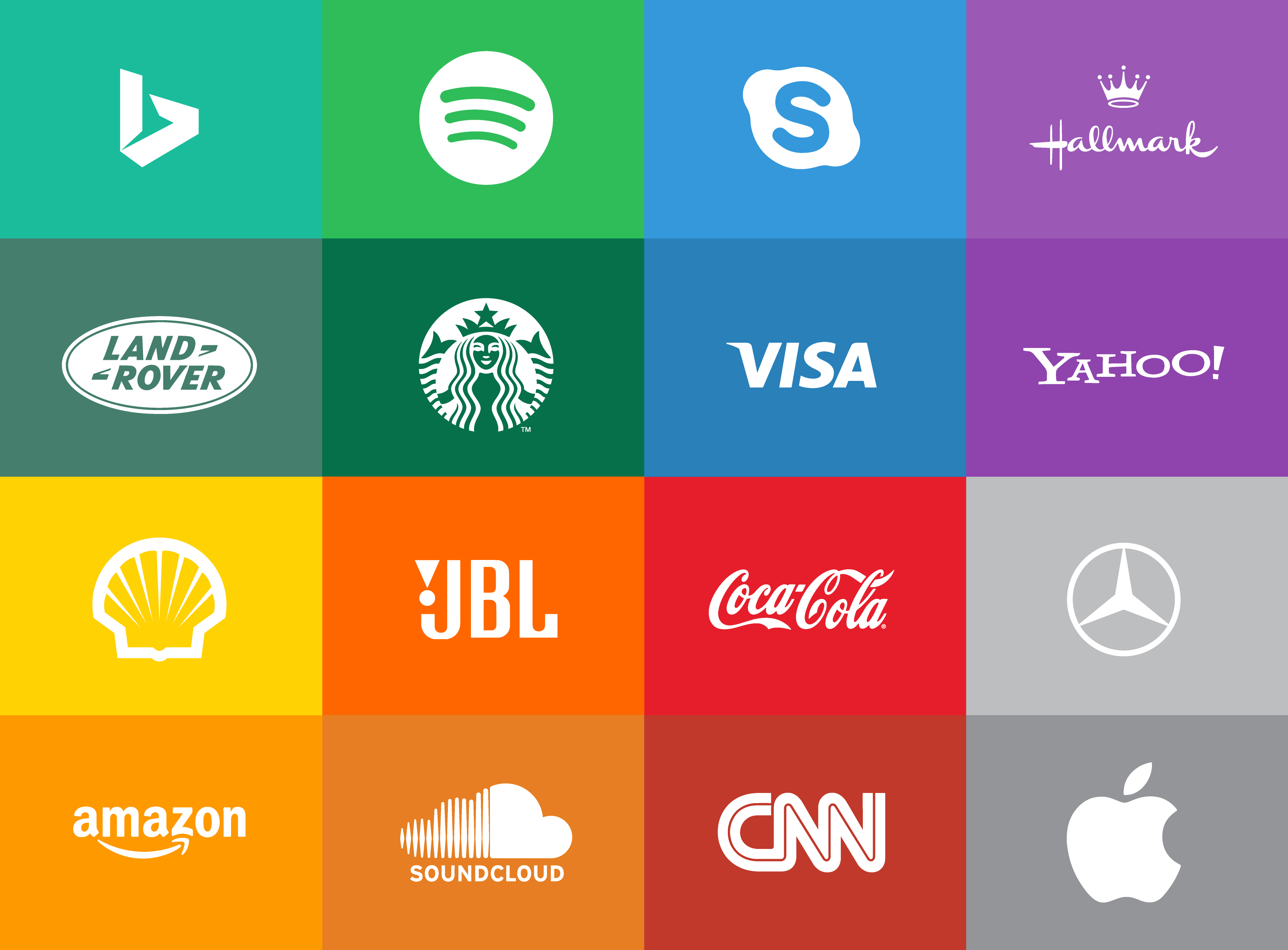
The grid above shows how this plays out. Spotify and Starbucks share green, Skype and Visa share blue, Coca-Cola and CNN share red, and yet nobody confuses them. Color sets the mood, while shape, type and consistent use make each brand its own. For more on why brands work the way they do, read our piece on the psychology behind branding.
What each brand color tends to signal
Treat these as tendencies, not rules. The shade, the pairing and the industry all change the message. A muted forest green says something very different from a neon lime. Each color below links to a deeper guide with brand examples.
Red
Red is energy, urgency, appetite and passion. It grabs attention faster than almost any other color, which is why food, entertainment and retail brands love it. Used heavily it can feel aggressive, so many brands pair it with plenty of white. More in our guide to red in branding.
Orange
Orange is friendly, confident and playful. It has some of red’s energy without the sense of alarm, so it suits brands that want to feel approachable and active, such as delivery, fitness, kids’ products and creative tools. See orange in branding.
Yellow
Yellow reads as optimism, warmth and attention. It is cheerful and very visible, but pale yellow on white is almost unreadable, so it usually needs a dark partner for text. See yellow in branding.
Green
Green signals nature, health, growth and, in finance, money. It is one of the most flexible brand colors: earthy greens suit organic and outdoor brands, while bright greens feel fresh and digital. The catch is that “eco green” is crowded, so it needs a distinctive shade. See green in branding.
Blue
Blue is the safe, trustworthy choice and one of the most common colors in corporate logos. It suits banks, tech, healthcare and insurance. Its popularity is also its weakness: in many sectors a blue logo blends in with every competitor. See blue in branding.
Purple
Purple carries ideas of luxury, creativity and imagination. Deep purples feel premium and a little mysterious, while lighter lilacs feel soft and calm. It is popular with beauty, wellness and creative software brands. See purple in branding.
Pink
Pink ranges from playful and sweet to bold and rebellious. Pastel pinks feel gentle, while hot pinks feel loud and confident. It is no longer limited to products aimed at women: fintech, food and tech brands now use it to stand out. See pink in branding.
Brown
Brown is earthy, honest and dependable. It works for coffee, chocolate, leather goods, outdoor gear and craft products, where warmth and a handmade feel matter. On its own it can look dull, so an accent color helps. See brown in branding.
Black, white and gray
Black says sophistication, authority and luxury, which is why so many fashion and premium brands use little else. White suggests simplicity, space and clarity. Gray feels neutral, calm and technical. All three are also the backbone of almost every palette as neutrals for text and backgrounds. For examples of dark, minimal palettes, browse our luxury logo ideas.
Brand color meanings at a glance
| Color | Often signals | Common in | Watch out for |
|---|---|---|---|
| Red | Energy, urgency, passion | Food, retail, entertainment | Can feel aggressive or like a warning |
| Orange | Friendliness, confidence, fun | Delivery, fitness, kids’ brands | Can look cheap in very bright shades |
| Yellow | Optimism, warmth, attention | Food, transport, budget brands | Poor contrast on white |
| Green | Nature, health, growth, money | Organic, wellness, finance | Crowded “eco” territory |
| Blue | Trust, calm, competence | Tech, banking, healthcare | Blends in with competitors |
| Purple | Luxury, creativity, imagination | Beauty, wellness, creative tools | Can feel distant if too dark |
| Pink | Playfulness, warmth, boldness | Beauty, food, fintech | Shade changes the message a lot |
| Brown | Honesty, warmth, reliability | Coffee, outdoor, craft | Can look dull without an accent |
| Black | Luxury, authority, sophistication | Fashion, premium products | Can feel cold or heavy |
How to build a brand color palette
A brand color palette is more than a favorite color. It is a small, documented system that tells everyone which colors to use, where and how much. Here is the process we follow.
1. Start with the brand, not the color wheel
Write down three to five words for the brand’s personality and the audience it serves. Then collect the logos and websites of its closest competitors and note which colors dominate. The aim is a color that fits the personality and still stands apart in the market. Our brand design process covers this research stage in more detail.
2. Choose one primary color
The primary color is the one people should remember. It usually appears in the logo and on key actions such as buttons. Pick one, not three. A brand that owns a single color is easier to recognize than one that spreads itself across many.
3. Add one or two secondary colors
Secondary colors support the primary color and give you room for illustrations, charts, campaigns and highlights. Complementary colors (opposite on the wheel) add contrast and energy. Analogous colors (next to each other) feel calmer and more unified. Keep the count low so the palette stays recognizable.
4. Pick your neutrals
Most of a website or document is neutral: text, backgrounds, borders and dividers. Choose a near-black for text, an off-white or white for backgrounds and one or two grays. Slightly warm or cool neutrals can tie in with the main color. A common rule of thumb is roughly 60% neutral, 30% secondary and 10% accent, which keeps the strongest color special.
5. Check contrast and accessibility
Every text and background pairing should be readable. The WCAG guidelines ask for a contrast ratio of at least 4.5:1 for normal body text, and you can test any pair in the free WebAIM contrast checker. Also avoid using color as the only way to carry meaning. Color vision deficiency most often makes red and green hard to tell apart, so add icons, labels or patterns to error states and charts.
6. Build tints and shades
One hex code per color is not enough for real work. Create a scale for each main color, from light tints for backgrounds to dark shades for text and hover states. Many design systems use around five to ten steps per color. This gives designers and developers options without inventing new colors along the way.
7. Define the codes for every medium
Screens and print reproduce color differently. Record each color as HEX and RGB for digital, CMYK for print and, if the brand prints a lot, a Pantone match. Then put the whole palette, with usage rules and examples, into a brand guideline document so everyone works from the same source.
8. Test it in the real world
Put the palette on actual layouts before you sign it off: a homepage, a social post, a business card, a product label and a dark mode screen. Print a sample, look at it on a cheap phone and view it in grayscale. Colors that look balanced in a swatch often behave very differently at full scale. Our guide to color schemes in web design shows how palettes work across a site.
Common brand color mistakes
- Choosing a personal favorite. The color should suit the brand and its audience, not the founder’s taste.
- Copying the category leader. Matching the biggest competitor’s color makes you look like a follower and harder to remember.
- Using too many colors. Five bright colors with equal weight read as noise. One leading color with support is clearer.
- Ignoring contrast. Light gray text, yellow on white and red on green all fail many readers.
- Forgetting print and small sizes. A glowing screen color can turn muddy in CMYK, and thin colored details vanish at favicon size.
- Inconsistent use. Slightly different shades on the website, packaging and social media weaken recognition. Our article on bad branding covers more traps like this.
Color is one part of a bigger system. To see how it works with your logo, typography and imagery, read the key elements of a visual brand identity.
Frequently asked questions
What are brand colors?
Brand colors are the specific set of colors a business uses consistently across its logo, website, packaging and marketing. They are defined with exact codes (HEX, RGB, CMYK, Pantone) so they look the same everywhere.
How many colors should a brand have?
Most brands do well with one primary color, one or two secondary colors and a few neutrals. That is enough for flexibility without losing recognition. Large brands with many products sometimes add an extended palette, but the core stays small.
What is the best color for a brand?
There is no single best color. The right one fits the brand’s personality and audience, stands out from competitors and has enough contrast to work in real use. A distinctive color used consistently beats a “perfect” color used badly.
Do color meanings change between cultures?
Partly. Many color and emotion links are shared across countries, but local language, traditions and geography shift them. White, for example, is linked to weddings in some cultures and mourning in others. If a brand works across markets, check its colors with people from each one.
How do I make sure my brand colors are accessible?
Test every text and background pair with a contrast checker and aim for at least 4.5:1 for body text. Do not rely on color alone to show meaning, and check your designs with a color blindness simulator before launch.
Need a brand color palette for a client?
Inkyy is a white label design and development team for agencies. Our in-house brand designers build complete identities, from logo and brand colors to guidelines, that you deliver under your own brand. See our design services or book a 15-minute call.